Klarna's AI Bet
How much customer service should a machine do?

In April 2025, Klarna put its stock market debut on hold. The Swedish payments company had filed to list in New York the month before. Then, a wave of new US tariffs sent markets sliding, and the listing was postponed with no new date.1
The pause left Sebastian Siemiatkowski, Klarna's co-founder and chief executive, with a question he could no longer defer. For more than a year, he had told investors, journalists and his own staff that artificial intelligence would let Klarna do far more with far fewer people. The proof cited most often sat in customer service. An AI assistant launched in February 2024 was, by the company's own account, doing the work of 700 full-time agents.2
The numbers behind that story looked strong. Revenue per employee was approaching $1 million a year, up from $575,000 a year earlier.1 Headcount had fallen for two years straight. The assistant answered in about two minutes, in more than 35 languages, at any hour.
The complaints were harder to put on a dashboard. Customers said the answers were generic. Complicated cases went round in circles. Reaching a person took effort.3 For most companies, that would be a service problem. For Klarna, which lends money to millions of shoppers, a confused customer can become a missed payment, a dispute or a complaint to a regulator.
Siemiatkowski had to decide how much of Klarna's relationship with its customers he was willing to hand to a machine. He could keep automating and protect the efficiency story that investors were about to put a price on. Or he could spend money, months before a public listing, to bring people back.

Buy now, pay later
Siemiatkowski founded Klarna in Stockholm in 2005 with Niklas Adalberth, a friend from the Stockholm School of Economics. He was 23.4
The idea was simple: a shopper buys something online and pays later, or in a few interest-free instalments, without a credit card. The shop pays Klarna a fee on the sale, because shoppers who can split a payment buy more and abandon fewer carts. Klarna carries the risk that the shopper does not pay.
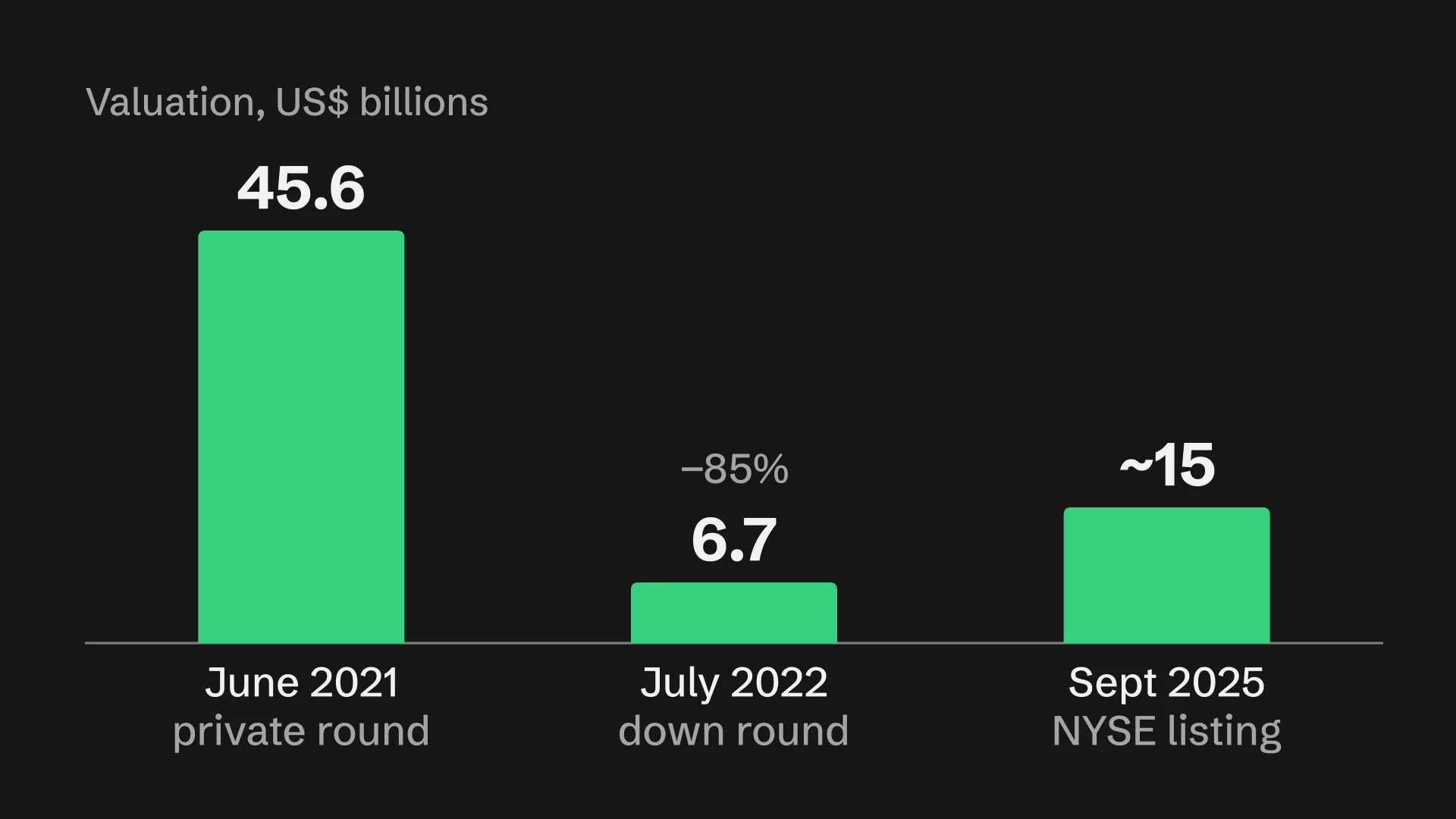
The model thrived on cheap money and online shopping, and both peaked in the pandemic. In June 2021, investors valued Klarna at $45.6 billion, making it one of Europe's most valuable private tech companies. It was spending heavily to win the United States, where it had 20 million users by the summer of 2021. At its peak, the US push burned through roughly $100 million a month.4
Then, interest rates rose and the market turned. In May 2022, Klarna laid off about 10% of its staff. In July, it raised $800 million at a valuation of $6.7 billion, 85% below the year before. It closed 2022 with a net loss of about $1 billion, the largest in its history.4
Siemiatkowski described the losses as "investments", and argued that the market would shrink, but Klarna's share of it would grow.4 The competition was not waiting. In March 2023, Apple launched its own pay-later service inside Apple Pay, putting instalments in front of hundreds of millions of iPhone users at no extra effort. PayPal, Affirm and Afterpay were already established, and card issuers, such as Citi, offered instalments of their own.4 Klarna's American business kept growing, reaching 34 million US users, and the United States overtook Germany as its largest market by revenue.4 But growth was no longer enough: investors now wanted to see that each new customer could be served at a profit.
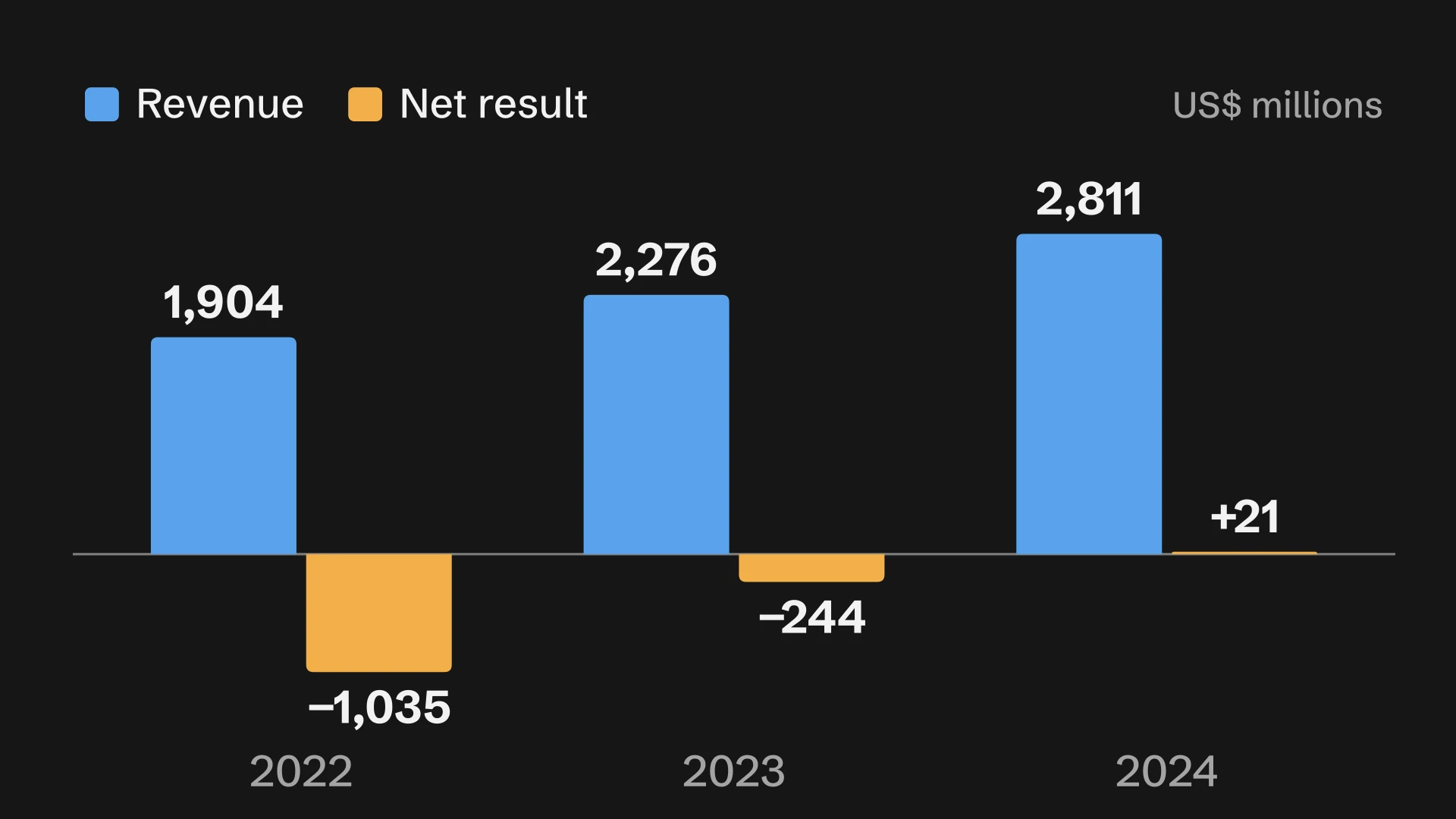
From then on, profitability came first. Over the next two years, revenue grew by almost half, while the loss disappeared (Exhibit 1). By 2024 it reported a net profit, a modest $21 million.5
Exhibit 1. Klarna's financial results, 2022–2024
A CEO convinced early
Siemiatkowski became one of the most outspoken corporate believers in generative AI, and one of the earliest. When OpenAI opened ChatGPT to outside plug-ins in March 2023, Klarna was one of the first 12 companies to launch one.4 In August 2023 it was the only bank among the launch customers of ChatGPT Enterprise, the business version of the tool.6
At that point about 2,500 of Klarna's 5,000 employees used AI tools every day. Siemiatkowski presented that as a figure to push higher, not a success to celebrate, and said he came to work thinking only about how AI could speed up the company's plans.6
He also acted on the belief. Late in 2023, Klarna stopped most hiring. It did not need layoffs to shrink: about one employee in five left every year, and departing staff were largely not replaced.7 In interviews, Siemiatkowski went further than most executives would. He said he believed AI could already do every job that humans do, his own included, and that the question was only how to apply it.8 He also told employees that Klarna's total salary bill would shrink, but that part of the gain would appear in the pay of those who stayed.8
Not everyone took the claims at face value. When he told Bloomberg Television in December 2024 that Klarna had stopped hiring a year earlier, TechCrunch counted more than 50 open roles on the company's careers page. A spokesperson said the CEO had been simplifying, and that Klarna was only backfilling essential roles, mainly in engineering.7
Customer service before the assistant
Most of what Klarna's customers wanted to know was simple. Did my payment go through? Where is my refund? How do I return this?9 The volume was enormous, the questions repeated, and the answers usually sat in the customer's own account.
Klarna did not employ most of the people answering. Like many large consumer companies, it bought customer service capacity from outsourcing firms, whose agents worked on Klarna's queue among others.10 That arrangement would matter later. When Klarna spoke of the assistant doing the work of 700 agents, it was describing contracted capacity it no longer needed to buy. It was not describing 700 Klarna employees losing their jobs.
Before the assistant, the average customer errand took 11 minutes to resolve.2
Not every contact was simple. A minority involved disputed charges, payments that had failed for reasons the customer did not understand, or people who could not pay what they owed. Those conversations carried most of the risk and most of the emotion. They were also the ones least like the others.
This split, a large volume of easy questions and a small number of hard ones, is typical of consumer customer service. It is also what makes the function such an obvious target for automation. If most of the cost sits in the easy questions, automating them takes out most of the cost. Whether it takes out most of the value is a different question.
The launch
On February 27, 2024, Klarna announced the results of its AI assistant's first month.2
The assistant was built with OpenAI's models. In plain terms, it was a language model, the technology behind ChatGPT, connected to each customer's own purchases, payments and refunds. A customer could ask a question in their own words and get an answer specific to their account, in more than 35 languages, at any hour, in 23 markets.2
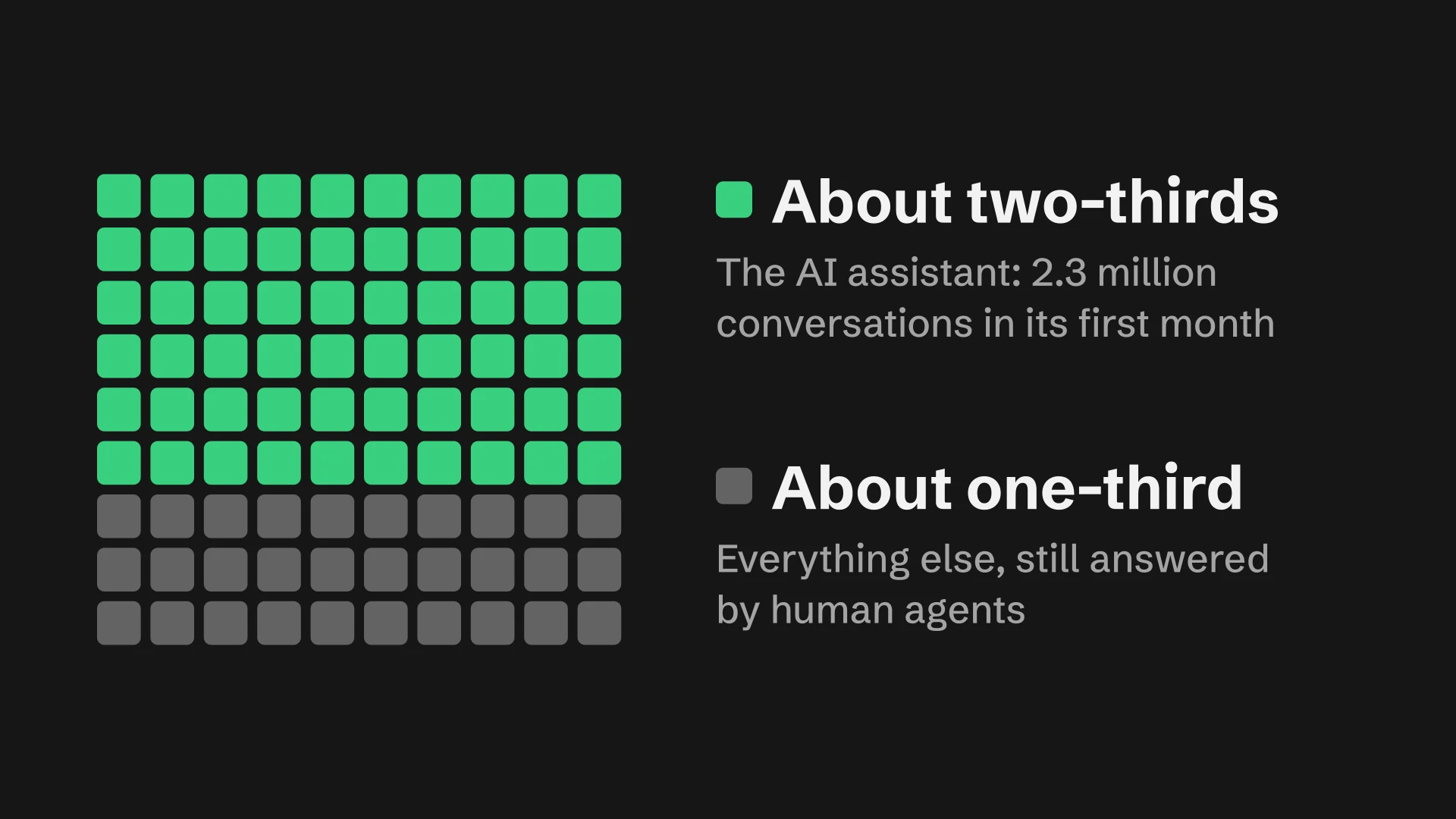
The headline figures were striking (Exhibit 2). In its first month the assistant held 2.3 million conversations, two-thirds of all of Klarna's customer service chats. Klarna said that was the work of 700 full-time agents. It said customer satisfaction was on par with human agents, that repeat inquiries had fallen by 25%, and that errands now took under two minutes instead of eleven. It estimated the assistant would improve profit by $40 million in 2024.2
Siemiatkowski framed it as a gain for everyone: better experiences for customers at lower prices, more interesting work for employees, better returns for investors. OpenAI's chief operating officer, Brad Lightcap, called Klarna a leader among the company's partners.2 One line in the announcement drew less attention. Customers could still choose to talk to a human agent if they preferred.2
Exhibit 2. What Klarna reported after the assistant's first month
| Measure | Reported result |
|---|---|
| Conversations | 2.3 million in the first month |
| Share of customer service chats | About two-thirds |
| Equivalent workload | 700 full-time agents |
| Customer satisfaction | On par with human agents |
| Repeat inquiries | Down 25% |
| Time to resolve an errand | Under 2 minutes, from 11 |
| Coverage | 23 markets, 35+ languages, 24/7 |
| Expected profit improvement | About $40 million in 2024 |
Source: Klarna press release, February 27, 2024.2
The announcement became one of the most cited examples of generative AI at work. It also drew sceptics. The software writer Gergely Orosz pointed out that automating first-line support was not new: Citibank had automated most of its phone support in 2008. He noted that 700 positions staffed around the clock correspond to considerably more people working in shifts, and that those people worked for outsourcing partners rather than for Klarna. He also raised a sharper question. Was it simply more exciting to build an AI chatbot than to fix the confusing products that made customers ask for help in the first place?10 In his reading, Klarna had spent for years as if money were free, and the chatbot partly corrected an inefficiency that cheaper interest rates had allowed to grow.10
Doing more with fewer people
Through 2024, customer service became the centrepiece of a larger story about the whole company.
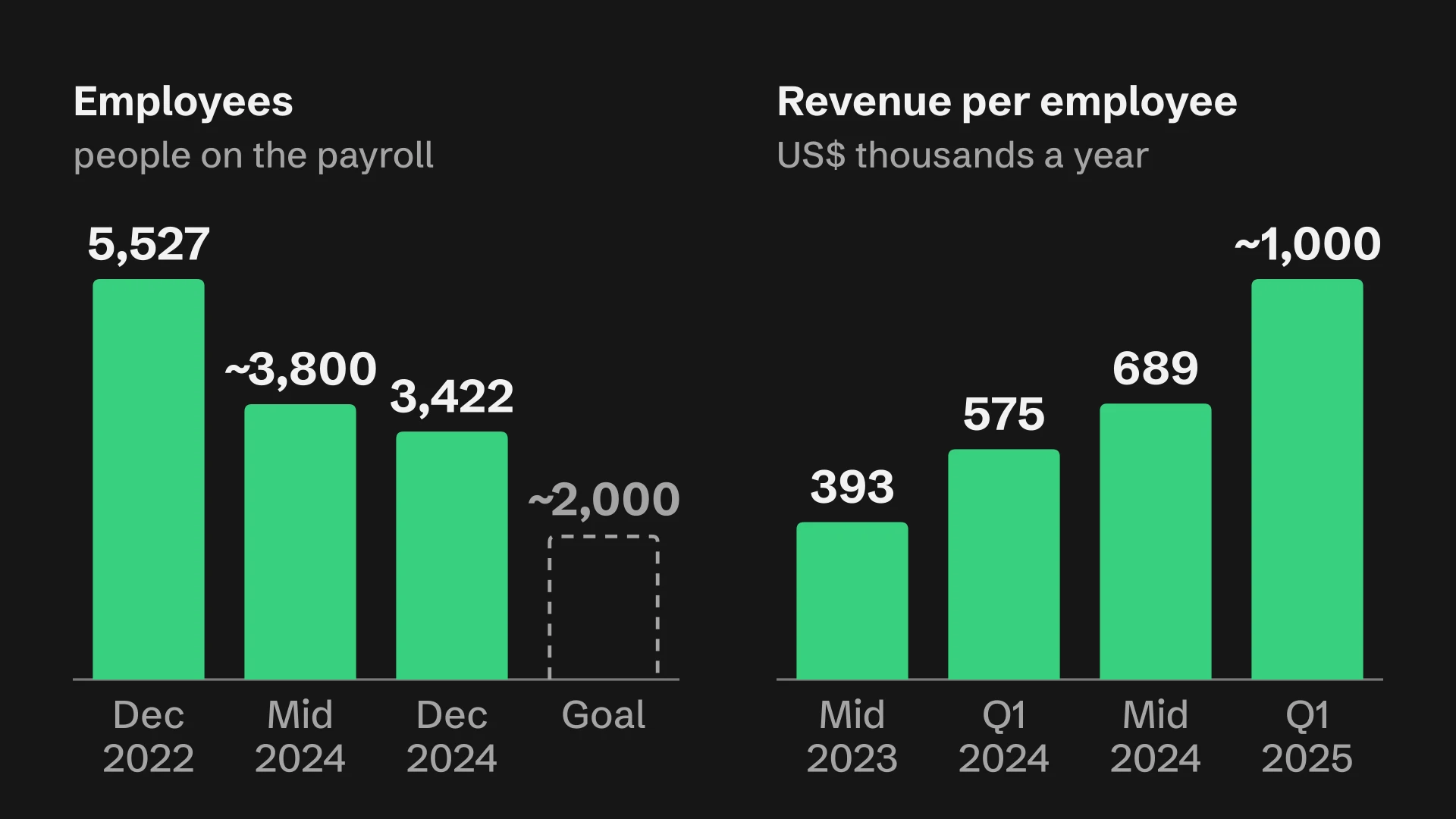
In August, Klarna reported that its headcount had fallen to about 3,800 from a peak of around 5,000, and that it aimed to reach about 2,000. There would be no traditional layoffs; departing employees would simply not be replaced. Revenue per employee had risen from about $393,000 to $689,000 in a year.11 Fortune noted that some of the improvement may have come from falling interest rates rather than from AI alone.11
AI was spreading beyond customer service. Klarna said it was saving about $10 million a year on marketing by using AI tools.8 It ended its contract with Salesforce, the customer-relationship software that many companies of its size treat as indispensable, as part of a broader effort to consolidate its software and data.112
The results reinforced the case. In the first quarter of 2025, Klarna's revenue rose 13% to $701 million. Revenue per employee neared $1 million, up 74% in a year (Exhibit 3).1
Exhibit 3. Fewer people, more revenue each
For investors weighing a listing, this was the heart of the pitch. Klarna was presenting itself not as a lender that happened to use technology but as a technology company that happened to lend: one whose costs would not rise in step with its customers.
The decision
By spring 2025, two accounts of Klarna's customer service existed side by side.
The first was the company's. On its measures, the assistant matched human agents on satisfaction, resolved problems faster and generated fewer repeat contacts. It had absorbed most of the volume and taken a large cost out of the business.
The second came from customers. They described answers that were polite and generic, cases that were passed around without being resolved, and the effort it took to reach a person when the assistant could not help.3 A satisfaction score collected at the end of a conversation does not easily capture the customer who abandoned it halfway, or who never got the answer they needed and stopped asking.
Both accounts could be true at once. The assistant could be excellent at the two-thirds of contacts it was built for, and still fail the remaining third, the cases with the most at stake.
For Klarna the stakes were specific. It was not a retailer that could make up for a bad service experience with a discount. It was a lender, and in Sweden a licensed bank. A customer who could not get a clear answer about a failed payment might miss the next one. A dispute handled badly could become a complaint to a regulator. Buy-now-pay-later firms were already under scrutiny for how easily consumers could take on debt.
The timing made the choice harder. Investors were being asked to value Klarna on its efficiency. Rebuilding human support would raise costs just as the company prepared to show them its numbers.
Siemiatkowski's options fell broadly into three.
Stay the course. Keep investing in the assistant and move it into harder, second-level cases. This was the cheapest path and the most consistent with everything Klarna had told the market. It assumed that the problems were teething troubles that better models would fix. If the problem was not capability but the absence of a person when it mattered, this path would deepen it.
Promise a human. Guarantee that any customer who asks can reach a person, and staff for it. This was the clearest signal to customers and the strongest protection for the brand. It would cost money, partly reverse the headcount story, and invite headlines that Klarna's AI had failed.
Build a flexible human layer. Recruit a pool of remote, part-time agents, paid well and scheduled flexibly, possibly drawn from Klarna's own users, to handle the cases the assistant could not. This promised human judgment at a lower cost than a permanent staff or an outsourcing contract. It was also untested: few companies had trusted gig-style workers with people's financial problems.
Exhibit 4. Klarna's options in spring 2025
| Option | Cost | Service quality | Brand and trust | Investor story |
|---|---|---|---|---|
| Stay the course | Lowest | Depends on the AI improving | At risk if complaints grow | Strongest |
| Promise a human | Highest | Best for complex cases | Strongest | Weakened |
| Flexible human layer | Medium | Unproven | Positive, if it works | Mixed |
Source: author's analysis.
Each path told a different story about what Klarna was. The first said it was a technology company that served customers through software. The second said it was a financial service that used software to serve people. The third tried to be both.
Outside observers were already arguing the point. Julie Geller, an analyst at Info-Tech Research Group, put the mainstream view plainly: AI should take the routine work and support human agents, not replace them, and customers need an easy path to a person when emotions or complexity rise.3 Gartner's survey of customer service leaders, run in March 2025, found that 95% planned to keep human agents.14 Against this, Klarna had evidence most companies lacked: more than a year of its own data showing the assistant could handle the bulk of contacts without a fall in measured satisfaction.
There were also questions that no option answered on its own. Who would decide which conversations went to a person: the customer, the assistant or a rule? How would Klarna know, early, that a customer was struggling rather than simply quiet? And if human service became something customers had to ask for, would the customers who most needed it be the ones least likely to ask?
What should Siemiatkowski do?
What happened next
On May 8, 2025, Siemiatkowski gave his answer to Bloomberg, and it was more candid than most executives allow themselves. He said that "cost unfortunately seems to have been a too predominant evaluation factor" in how Klarna had organised customer service, and that the result was lower quality.15 He said customers must always know they can reach a human if they want one, and that investing in the quality of human support was the company's future.15
Klarna chose, in effect, the second and third options together. It began recruiting human agents again, through a pilot it described as an "Uber-type" model: remote, flexible work aimed at students, people in rural areas and committed Klarna users.39 A spokesperson summed up the division of labour: AI for speed, people for empathy.3 Siemiatkowski later said that satisfaction among customers served by Klarna's own agents was much higher, and that outsourced agents were moved to other work rather than laid off.9
In June, at SXSW London, he went further. Human customer service, he said, would always be a VIP thing: if AI can do customer service, it will be the cheap customer service.129
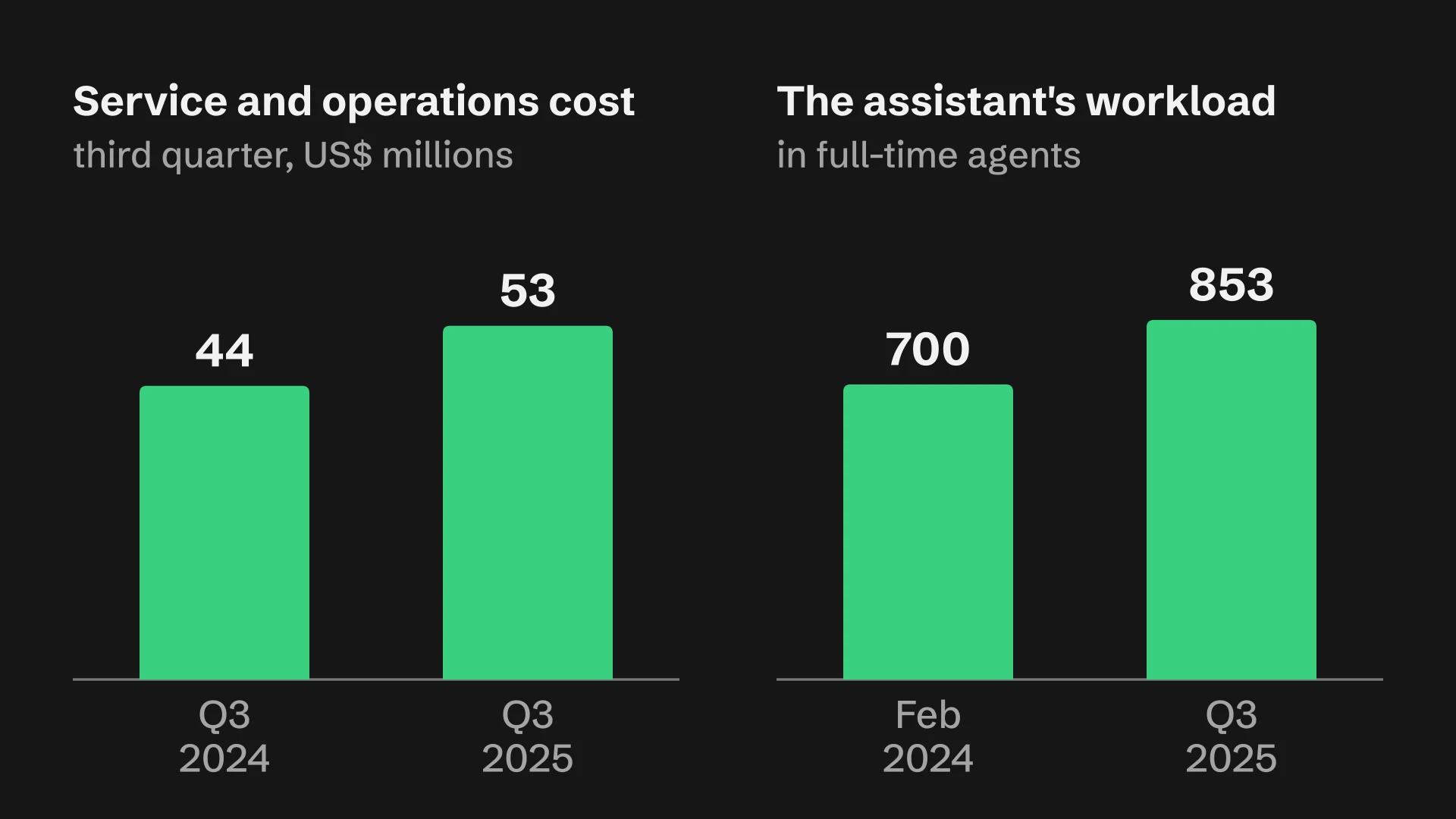
Klarna did not abandon the assistant. It continued to handle about two-thirds of customer chats, and Siemiatkowski said it was taking on more complex, second-level cases as the models improved.13 A year after launch, he said, it was still handling about 1.3 million errands a month. He also admitted to a habit of expecting change in three months that would really take three years.13 By the third quarter of 2025, Klarna said the assistant was doing the work of 853 agents and had saved $60 million.16
On September 10, 2025, Klarna listed on the New York Stock Exchange at $40 a share, valuing it at about $15 billion: a third of its 2021 peak, more than double its 2022 low.17
One line in its third-quarter results stands out against the story of the previous two years. Customer service and operations cost $53 million in the quarter, up from $44 million a year earlier.18
Commentary
The Klarna case is often told as a failure: a company replaced people with AI, and had to take it back. The record supports a more useful reading.
The metric measured conversations, not customers. Klarna's satisfaction score was on par with humans, and there is no reason to think it was wrong. But a score collected from conversations that ended says little about customers who gave up. Organisations get the quality they measure. If no number tracks how hard it is to reach a person, nobody is accountable for it.
Check what a headline number counts. "The work of 700 agents" was a volume measure, and the 700 were outsourced capacity. Both facts made the change look cleaner than it was. The human cost was real; it simply landed on another company's payroll.
The CEO named the failure himself. The most important line in the case is Siemiatkowski's own: cost had been too dominant a factor. The technology did roughly what it promised. The mistake was letting the cheapest answer decide which conversations it took, instead of deciding first which conversations a customer must be able to have with a person. That decision is not a technical one. It is a statement about what the company owes the people who use it, and it belongs to the leadership, not to the model.
Klarna did not retreat from AI. It changed what AI was for. Two years on, the assistant handled a larger workload than at launch. What changed was the promise around it: the simple majority of contacts for the machine, a guaranteed person for the rest.
Klarna is not alone. In June 2025, Gartner predicted that by 2027 half of the organisations planning to significantly cut their customer service workforce because of AI would abandon those plans.14 An IBM survey of 2,000 chief executives found that only a quarter of AI projects had delivered the return expected of them.15 Only 16% had been scaled across the whole business, and nearly two-thirds of the CEOs said competitive pressure led them to invest in technology before they understood its value.15 Klarna was early, loud and public about both its bet and its correction. That is what makes it worth studying.
Footnotes
-
"Klarna's revenue per employee soars to nearly $1M thanks to AI efficiency push," TechCrunch, May 19, 2025.
-
Klarna, "Klarna AI assistant handles two-thirds of customer service chats in its first month," press release, February 27, 2024.
-
"Klarna changes its AI tune and again recruits humans for customer service," CX Dive, May 2025.
-
"Sweden's Klarna burned through $100 million a month to become a buy-now-pay-later giant in the U.S.," Fortune, April 27, 2023.
-
Klarna Group plc, Form F-1/A, U.S. Securities and Exchange Commission, 2025.
-
Klarna, "Klarna is the only bank among ChatGPT Enterprise launch customers," press release, August 30, 2023.
-
"Klarna's CEO says it stopped hiring thanks to AI but still advertises many open positions," TechCrunch, December 14, 2024.
-
Klarna CEO on AI replacing human workers, Fortune, February 3, 2025, drawing on his Bloomberg and Sequoia Capital interviews.
-
"Klarna pursues 'Uber' style customer service model," CX Dive, 2025.
-
Gergely Orosz, "Klarna's AI chatbot: how revolutionary is it, really?," The Pragmatic Engineer, February 29, 2024.
-
Klarna's plan to shrink to about 2,000 employees, Fortune, August 28, 2024.
-
"Klarna CEO says company will use humans to offer VIP customer service," TechCrunch, June 4, 2025.
-
"Klarna CEO: We're giving AI more customer service work, not less," CMSWire, 2025.
-
Gartner, "Gartner predicts 50% of organizations will abandon plans to reduce customer service workforce due to AI," June 10, 2025.
-
"As Klarna flips from AI-first to hiring people again, a new landmark survey reveals most AI projects fail to deliver," Fortune, May 9, 2025, reporting Siemiatkowski's interview with Bloomberg.
-
"Klarna says its AI agent is doing the work of 853 employees," CX Dive, November 2025.
-
"Klarna IPO surges on NYSE debut," IG, September 10, 2025.
-
Klarna, "Klarna delivers record-breaking Q3 as AI-powered digital bank," November 18, 2025.